

For leaders shaping how their organisation works
Set a vision for your culture, and lead your teams to live it.
Red Bear: Enterprise Culture Manager helps leaders define the culture they want, turn a few principles into the decisions, policies and everyday interactions where culture actually lives, and coach their teams to apply them. Progress is measured from patterns, never individuals.
The problem
Information stops moving when people are afraid of what it will be used for
Values nobody can measure
Leaders name values, and every team hears a different five. The survey says 3.7, and nobody knows what to do on Monday.
Feedback arrives as a verdict
So managers defend themselves instead of learning. Culture change becomes a poster campaign with no plan behind it.
Problems found too late
Toxic patterns surface in exit interviews a year on, and nobody can say whether the programme moved anything, so it is cut.
How it helps leaders
From a vision on a slide to a culture people live every day
Most culture programmes stop at a list of values. Culture Manager takes leaders from the vision to the habits that change how decisions are made, how policies are written and how people treat each other, and shows whether it is working.
Set the vision
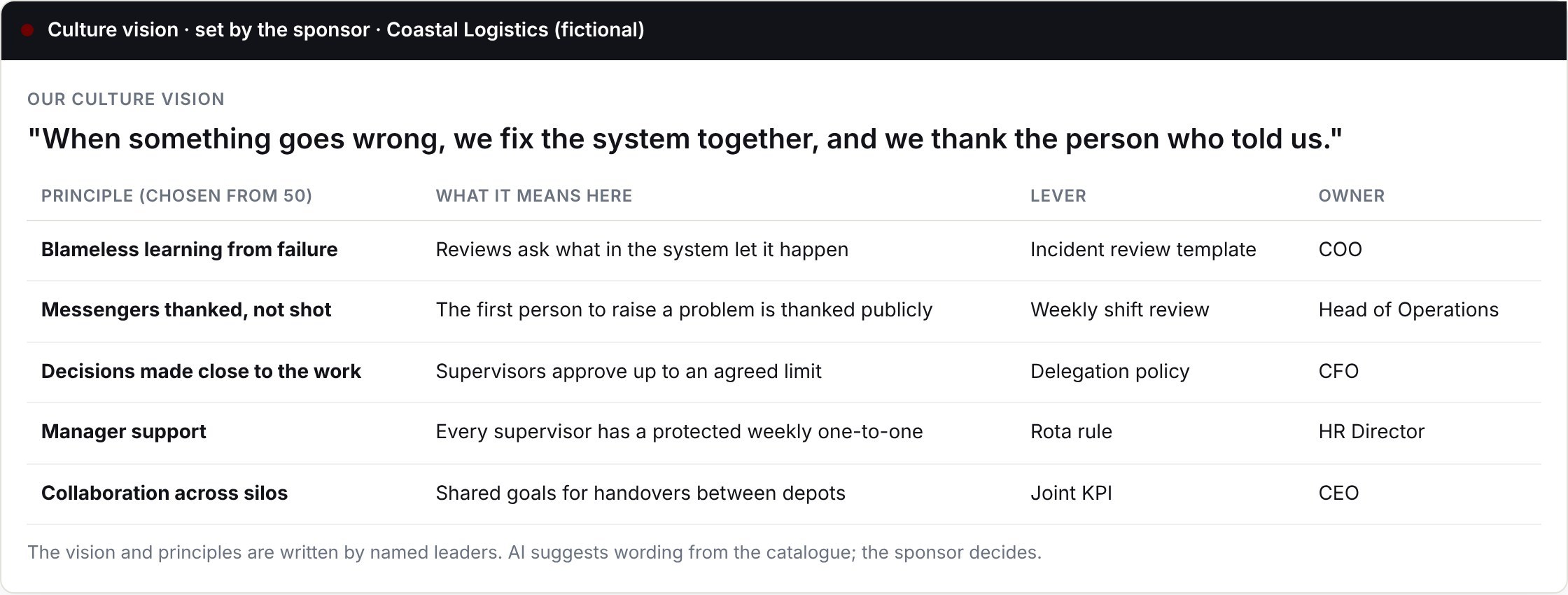
Leaders describe the culture they want, in their own words.
Choose the principles
Up to five, from a catalogue of fifty, each with a lever and an owner.
Put them into practice
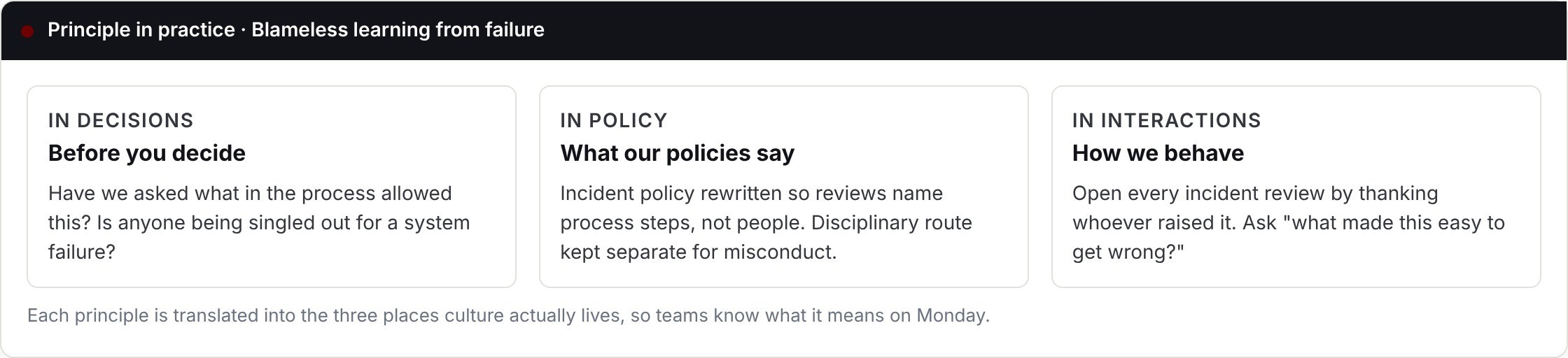
Each principle translated into decisions, policy and interactions.
Coach and lead teams
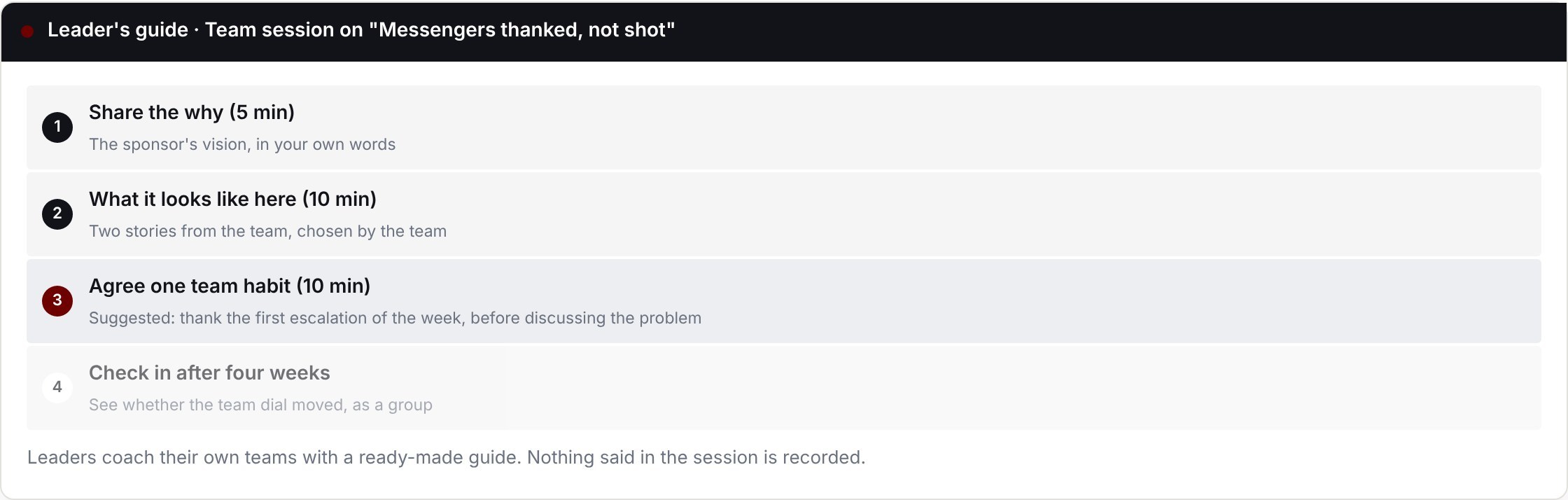
Guides for every leader, and private coaching where a pattern needs it.
Measure and adjust
Dials read from aggregated signals; what works is scaled.
Principles in practice
Culture lives in three places. Culture Manager works in all three.
How choices get made
Each principle becomes the questions a leader asks before deciding, so the culture shows up in the calls that matter most.
What the rules reward
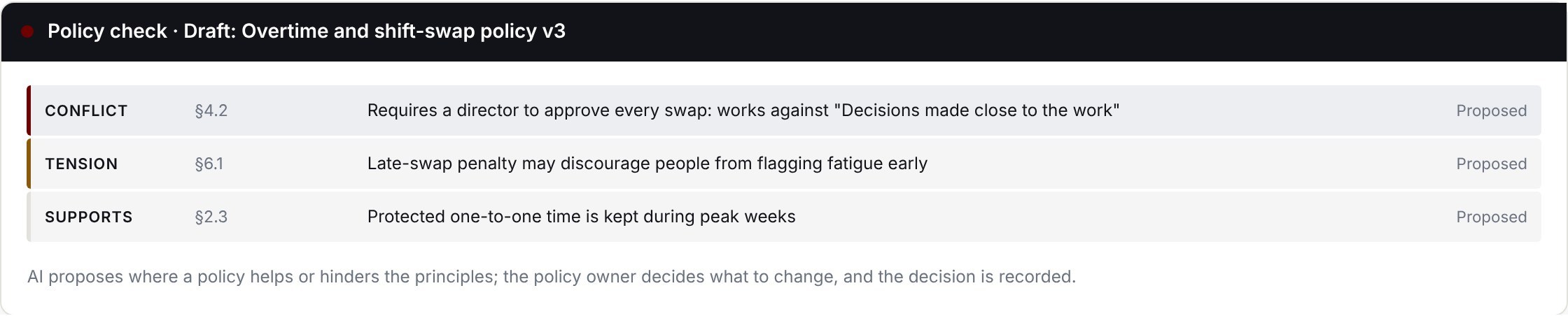
Draft policies are checked against the principles. Where a rule works against them, the policy owner sees why and decides what to change.
How people treat each other
Simple, specific habits for meetings, reviews and one-to-ones, agreed by each team for itself.
For leaders
A clear vision, principles with owners, a guide for every team conversation, and evidence of what is changing.
For teams
Principles that mean something on Monday, a say in their own team habits, and coaching instead of blame. Nobody is ever singled out.
See it working
From vision to practice to proof
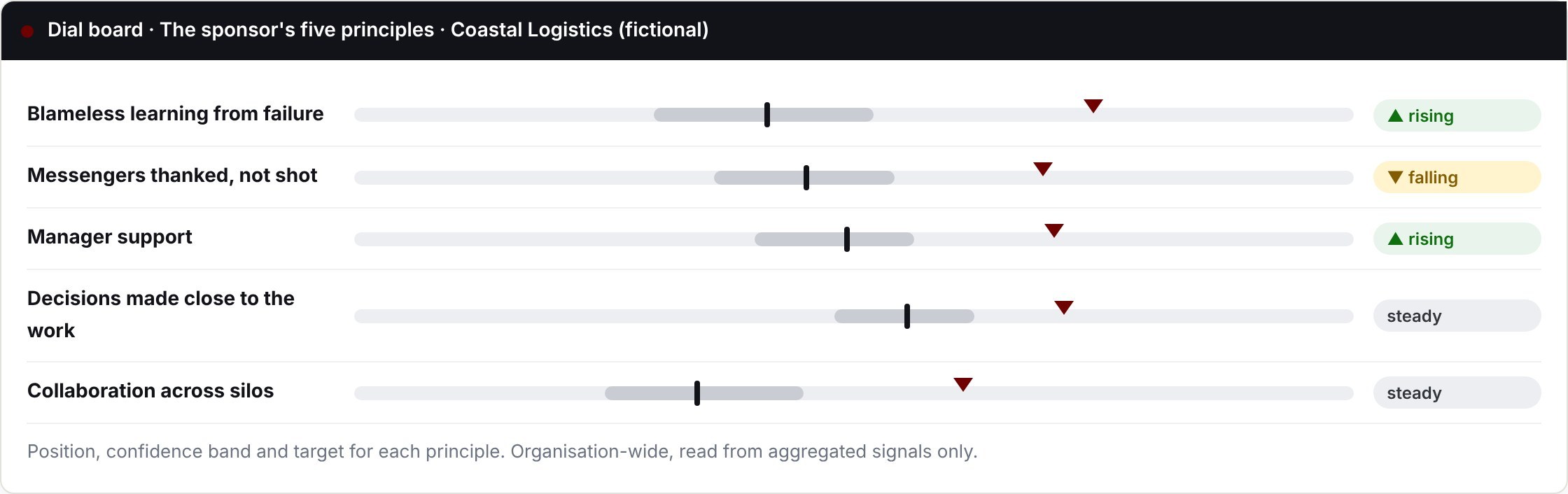
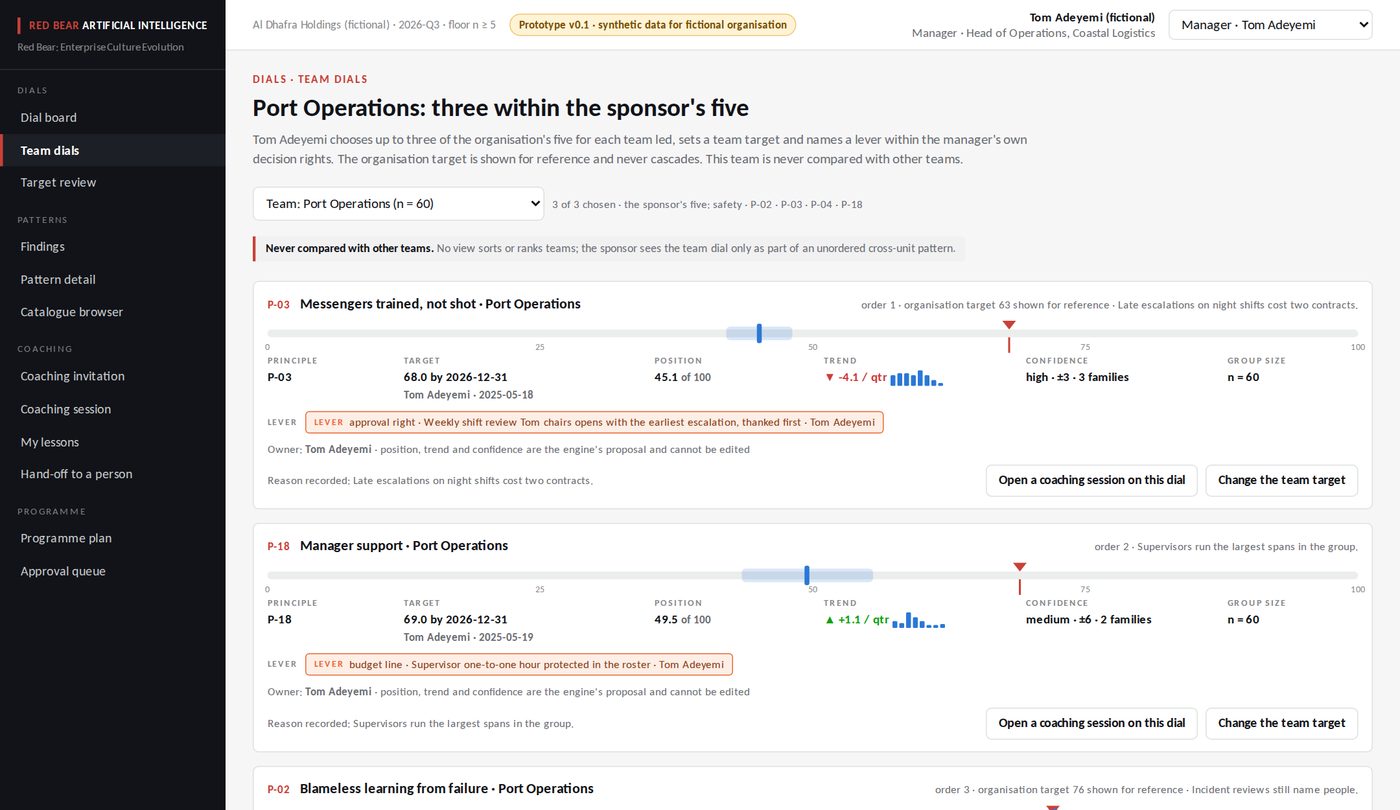
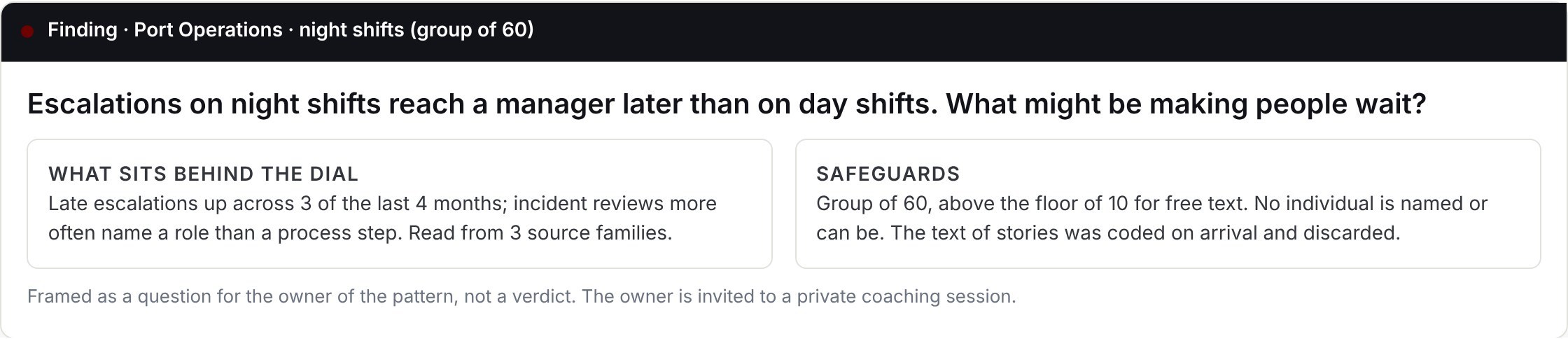
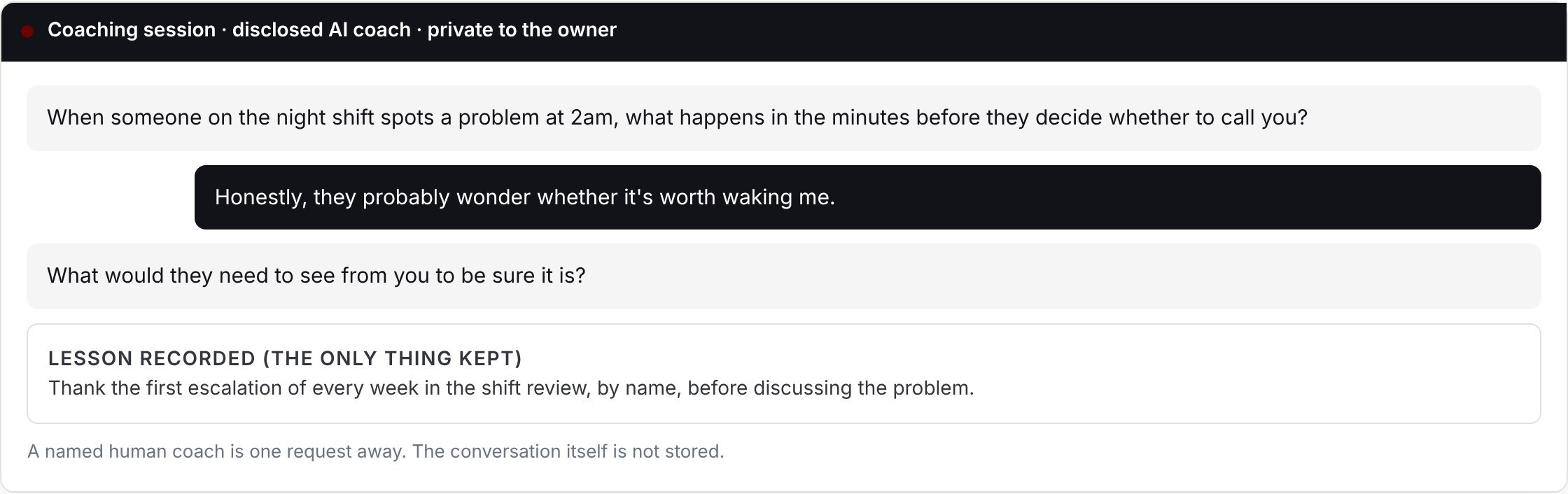
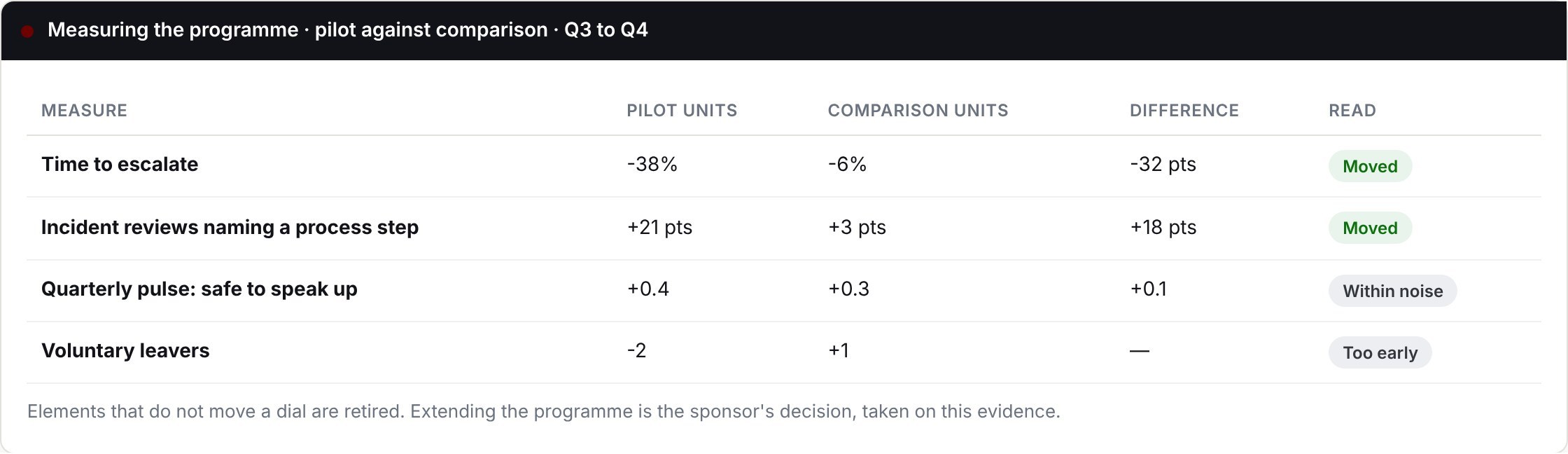
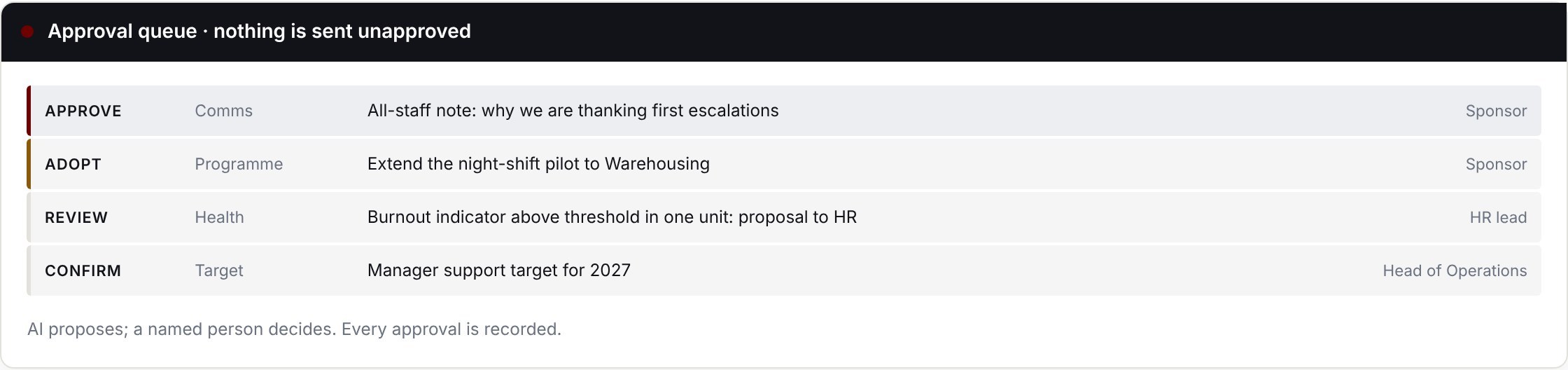
Conceptual screens drawn to the specification, and one screen from the working prototype, all with synthetic data for fictional organisations.
What's inside
Eight capabilities, one per function
Principles and Culture Dials
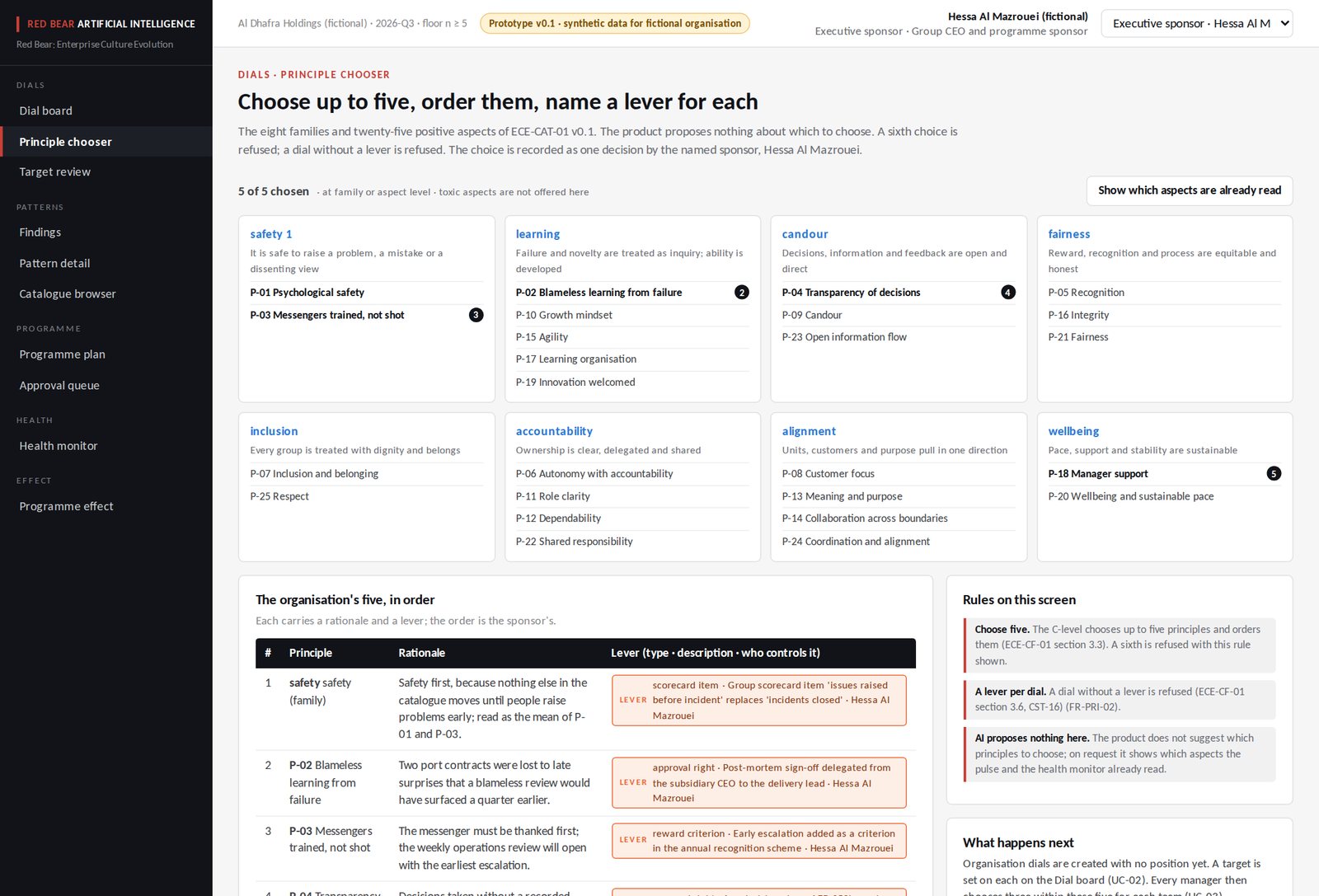
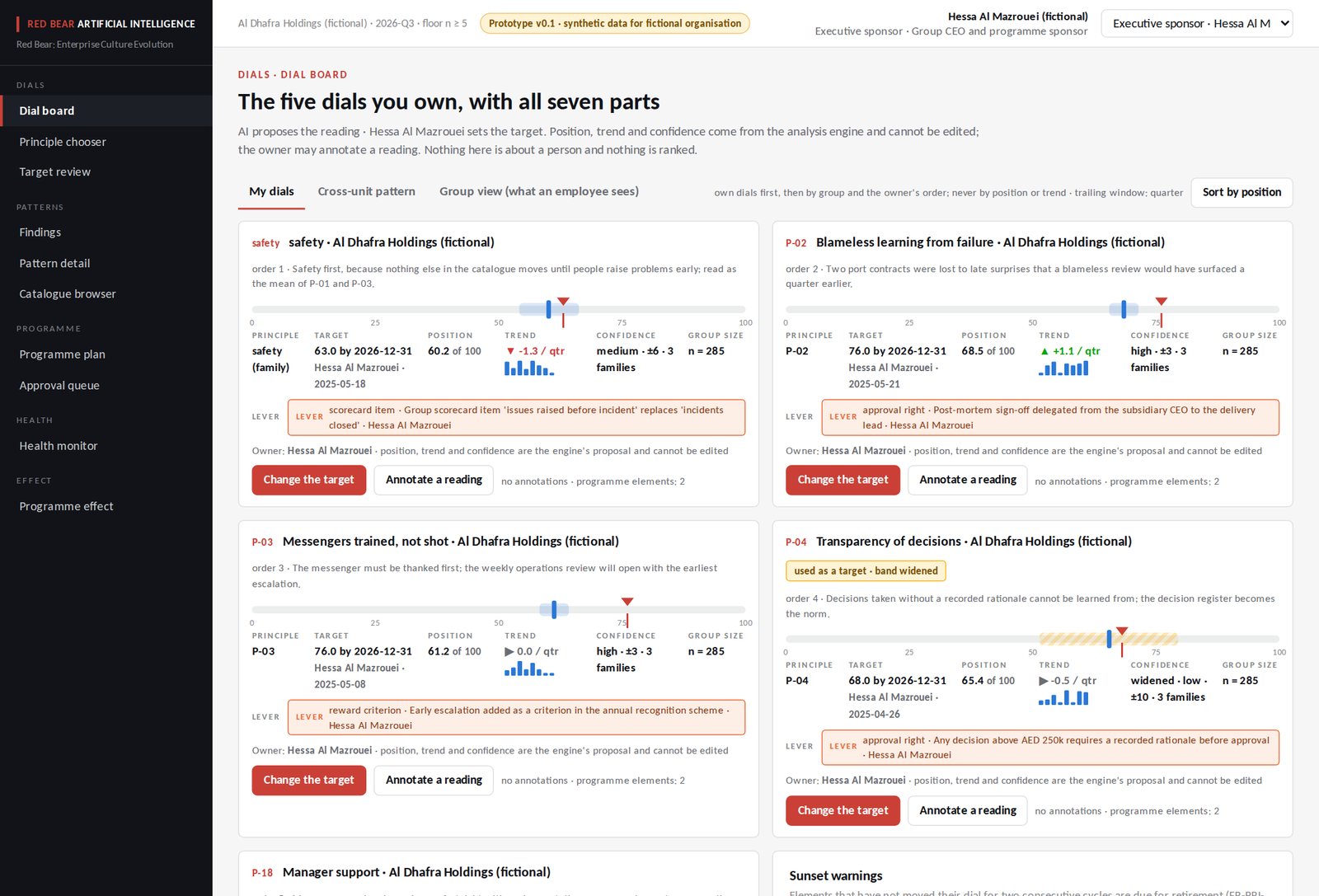
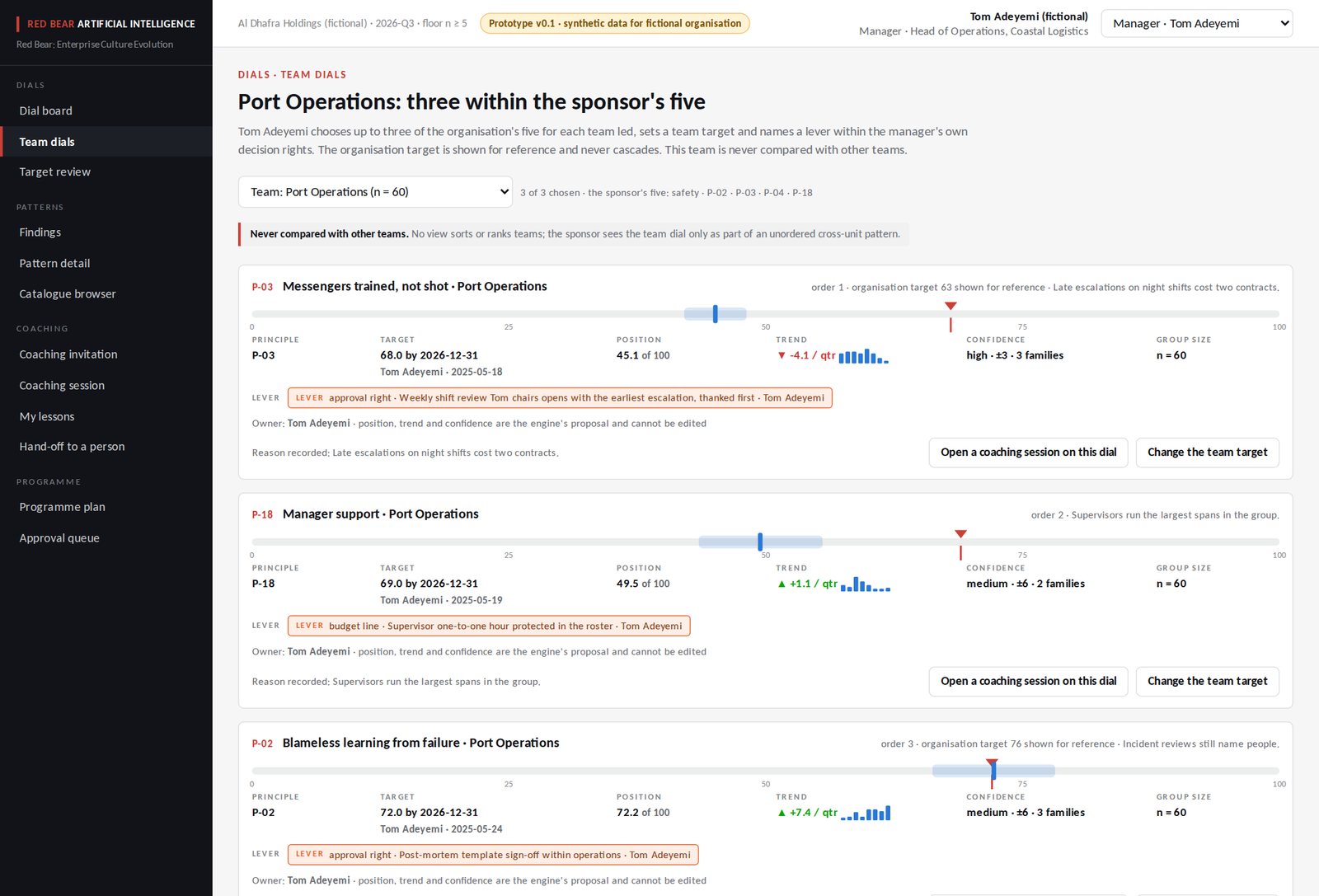
The C-level chooses up to five principles from a catalogue of fifty culture aspects, and each manager chooses up to three within them.
Signal intake
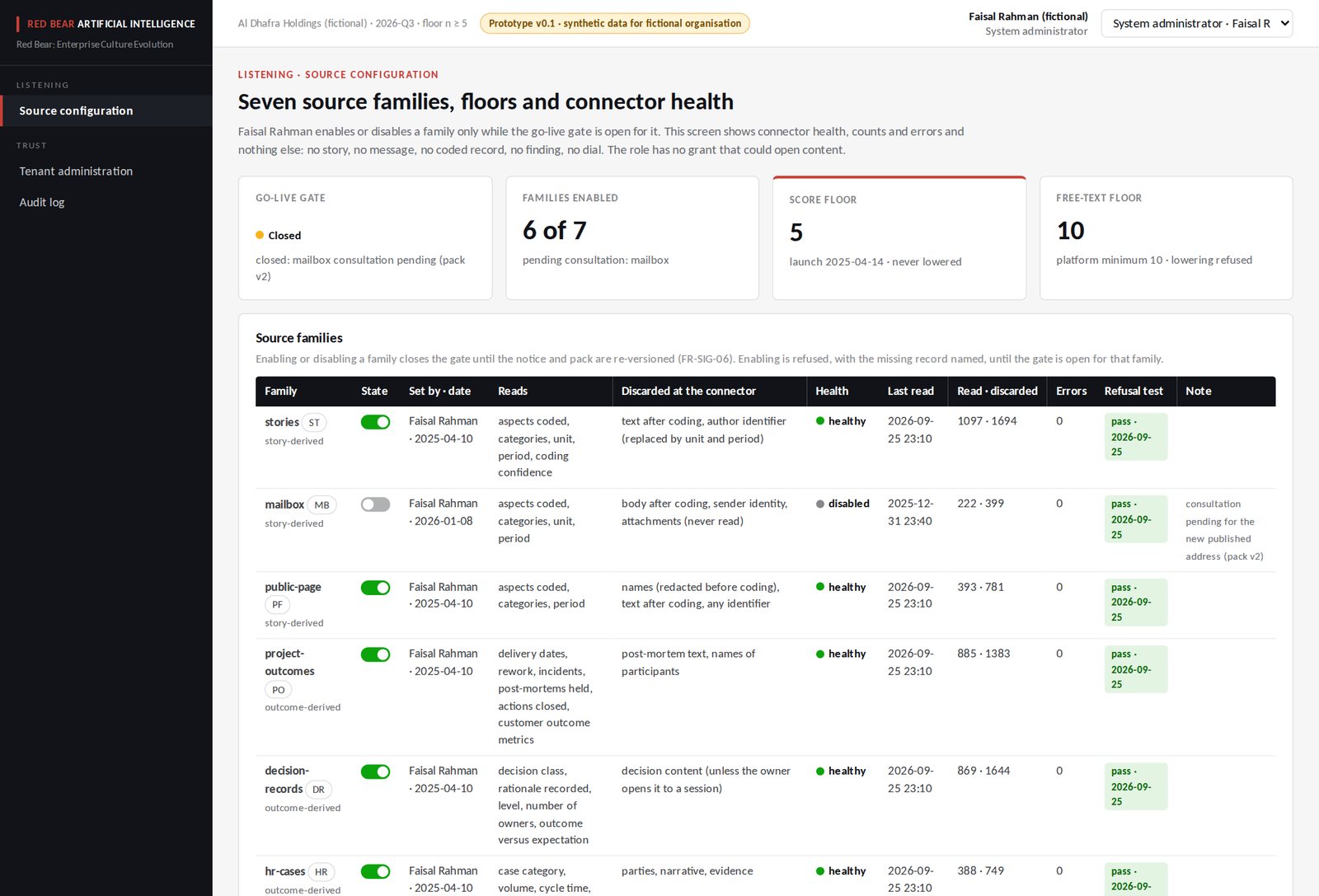
Stories, a monitored mailbox and a public page are coded to aspects on arrival, and the text is discarded.
Findings and patterns
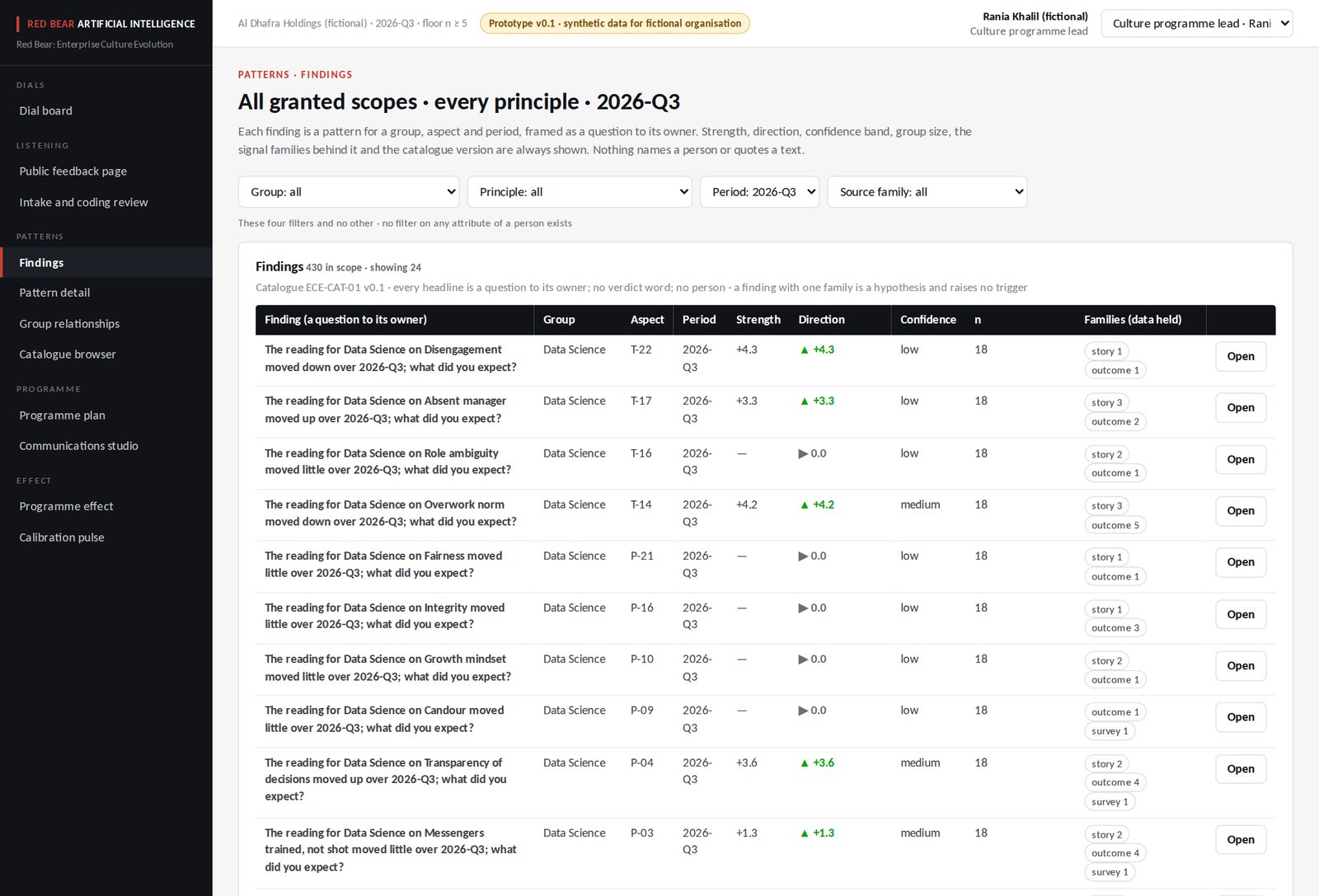
What sits behind a dial, framed as a question to its owner, and suppressed when the group is too small.
Coaching
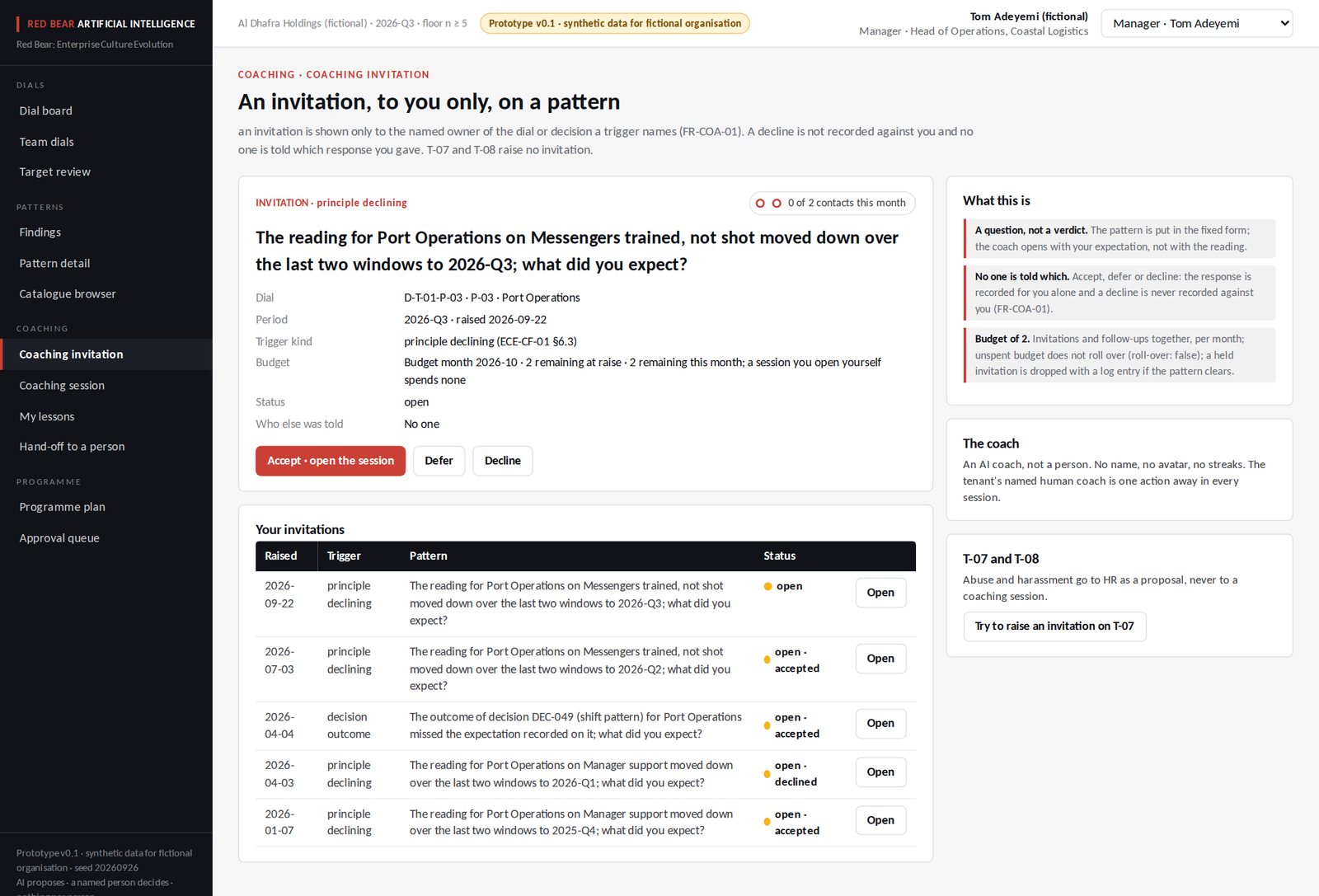
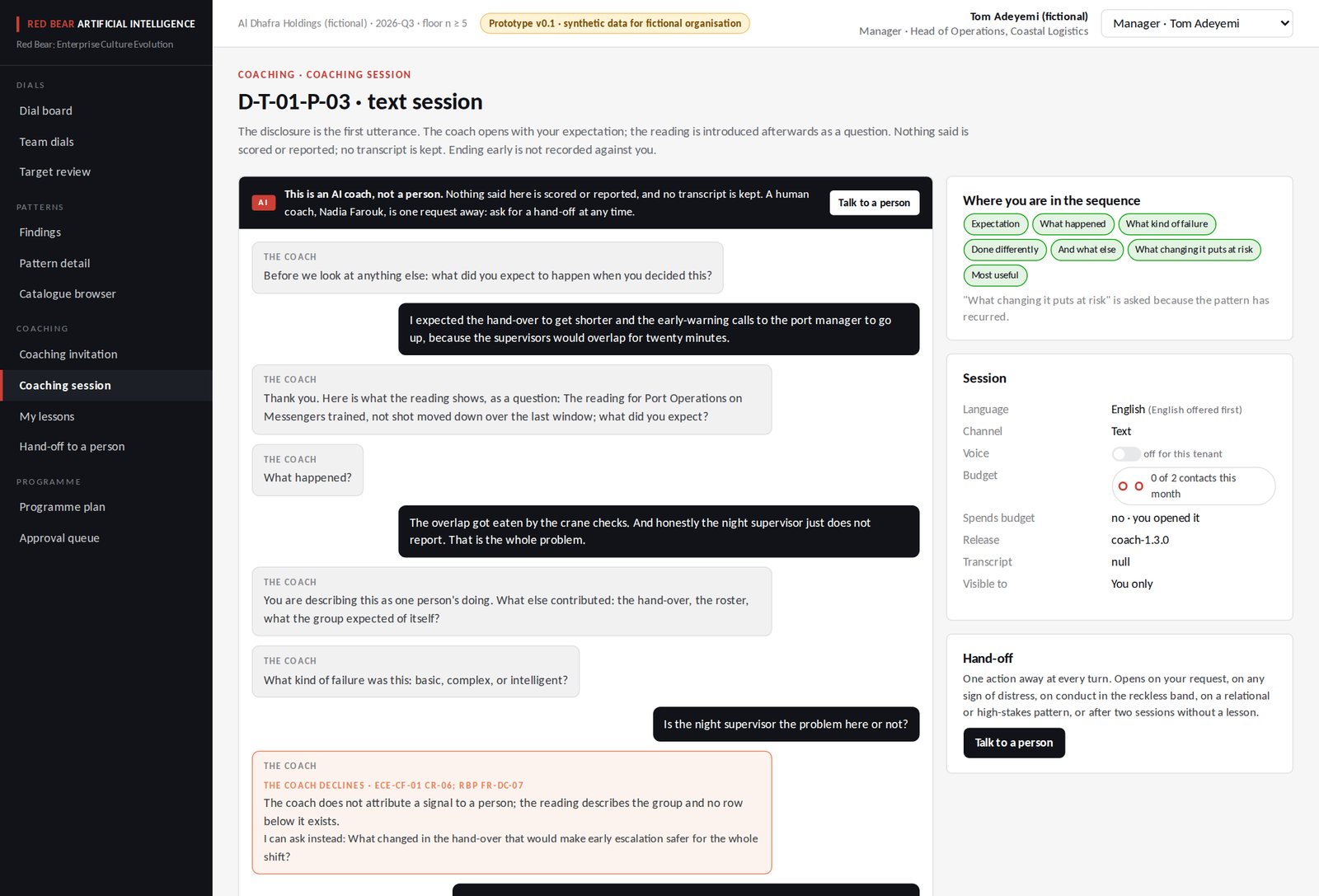
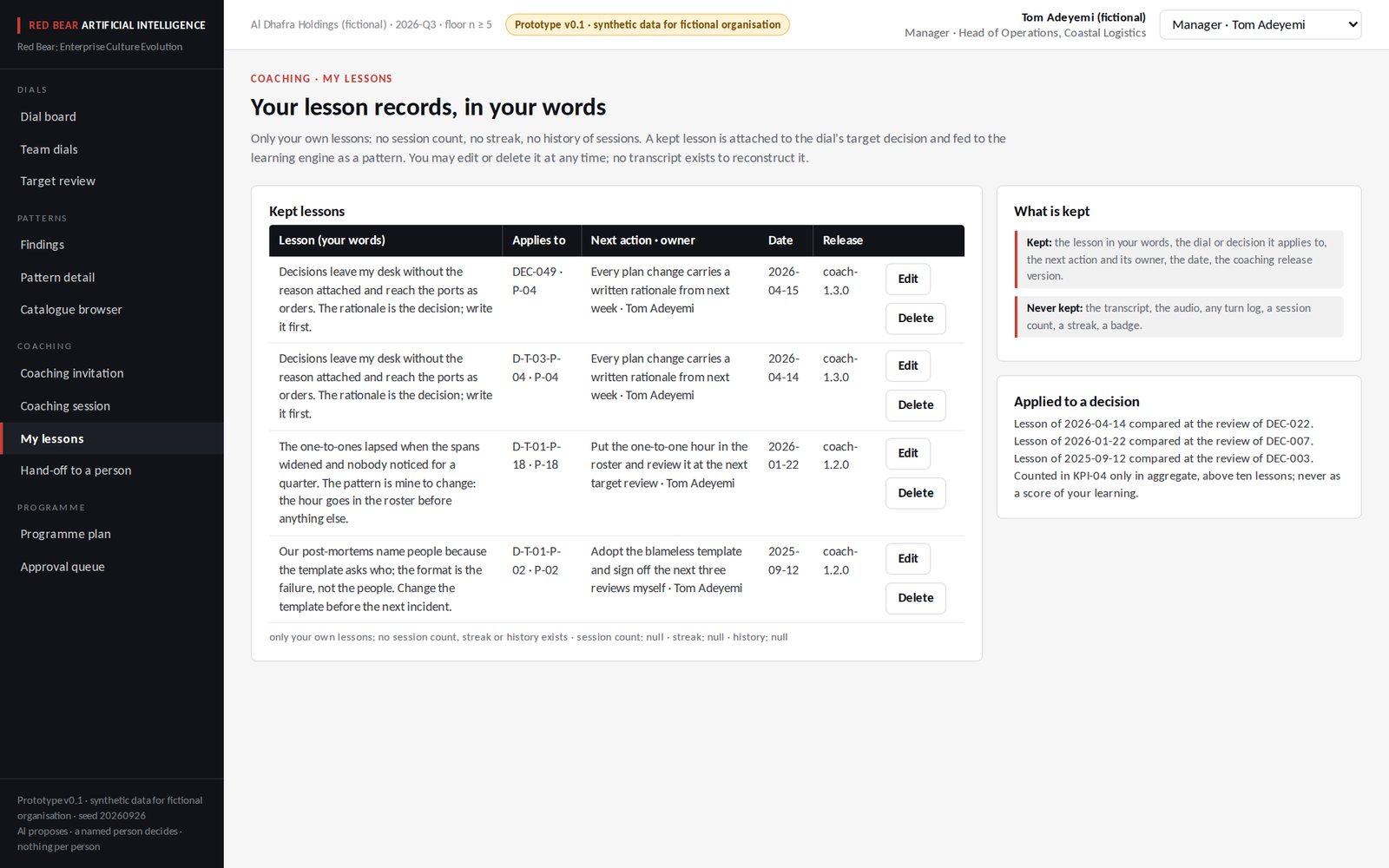
A disclosed Socratic session for the owner of a pattern, with a named human one request away. Only the lesson is kept.
Programme and communications
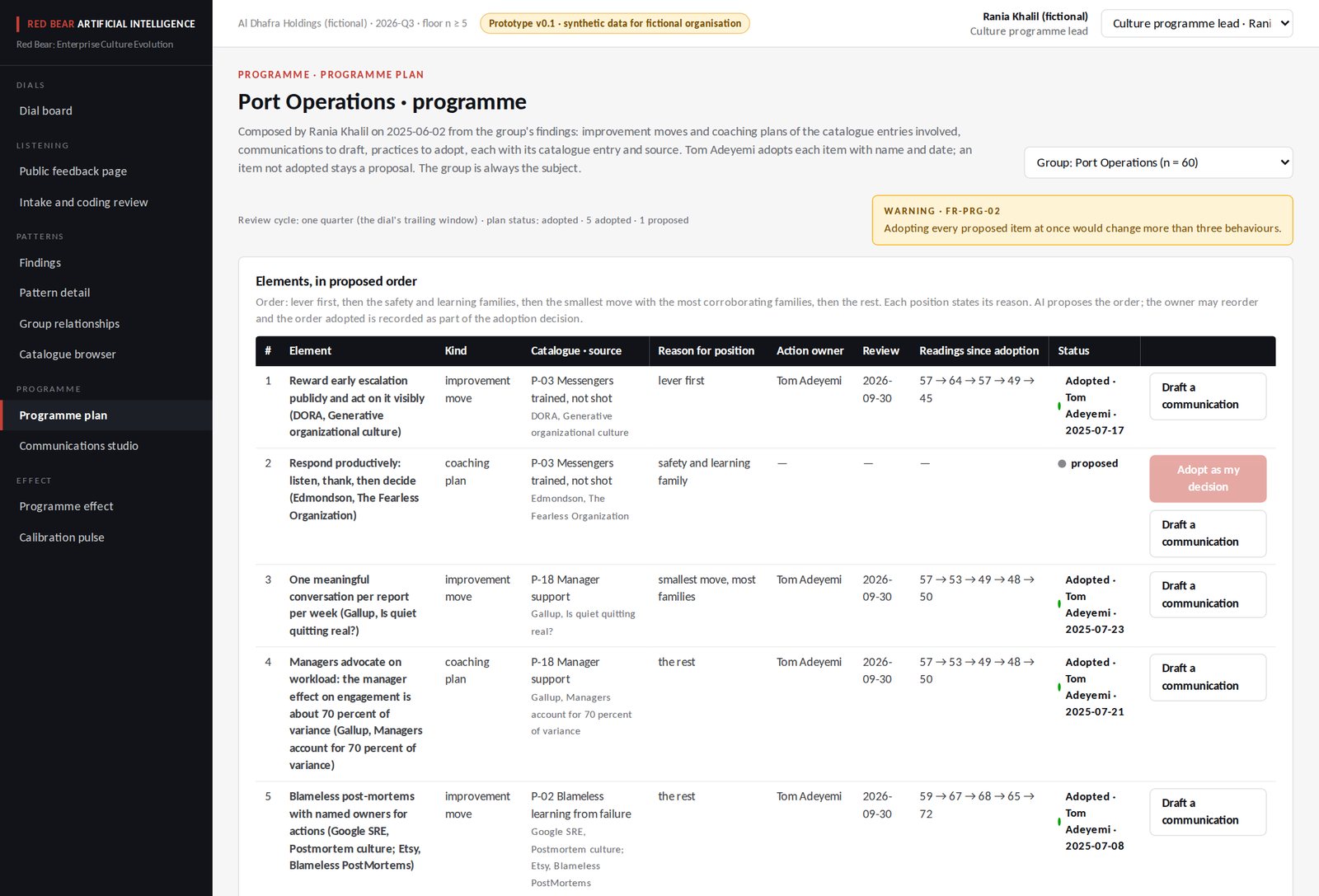
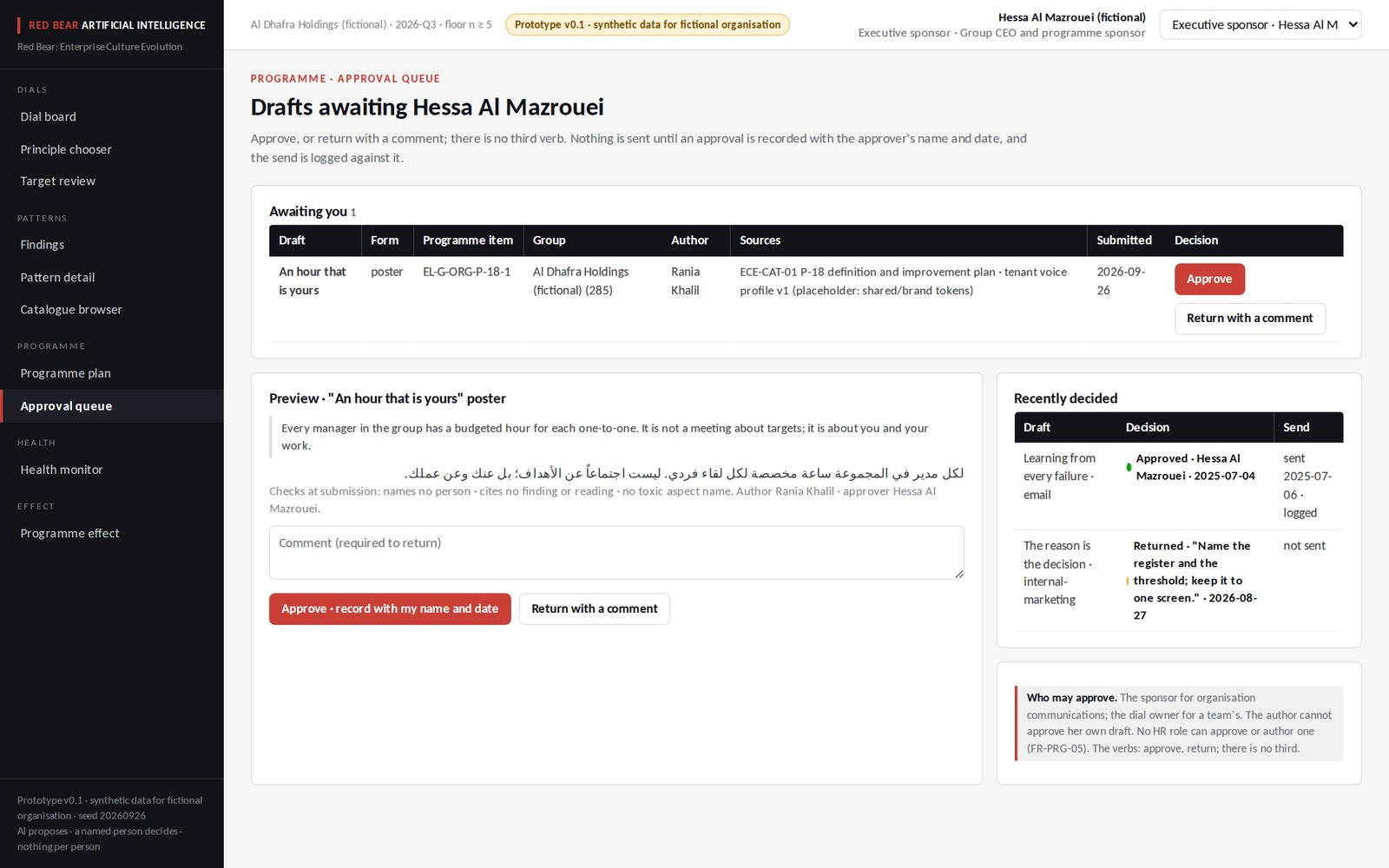
A programme per group, a pilot with a comparison before scaling, and drafts that are never sent unapproved.
Health monitoring
Toxic patterns and burnout indicators per unit above the floor. Abuse and harassment go to HR as a proposal, never to a coaching session.
Measuring the programme
Six measures, with the pilot read against its comparison, so you can see whether anything moved.
Governance and consultation
A consultation view, a staff notice and an impact assessment. No connector reads anything until they exist.
Patterns, never individuals
Built so the intrusive feature cannot exist
Aggregated first
Signals are grouped above a minimum size before any analysis runs: at least five for scores and ten for free text.
No text kept
Submitted text is coded on arrival and discarded. Collaboration data is headers and counts, never message bodies.
Nobody can look below the floor
No screen, export or API names a person against a signal. That includes administrators, because no such row exists.
AI proposes, a person decides
A named person sets the target, adopts the programme, approves the communication and records the lesson.
How you adopt it
Consultation first, then evidence, then scale
Consult
Workers' representatives review what the product will read and keep. The impact assessment and staff notice are written before anything connects.
Choose five
A named C-level sponsor chooses up to five principles and names a lever for each. Managers choose three within them.
Pilot on evidence
The programme runs first on matched units, with the outcomes recorded before it starts.
Scale
Extension is a sponsor decision, taken on dial movement against the comparison. Elements that do not move a dial are retired.
Screen by screen
The functionality, screen by screen
Screens from the working prototype, with synthetic data for a fictional organisation, grouped by the capabilities above. Select a screen to see it full size.
Principles and Culture Dials
Signals, findings and patterns
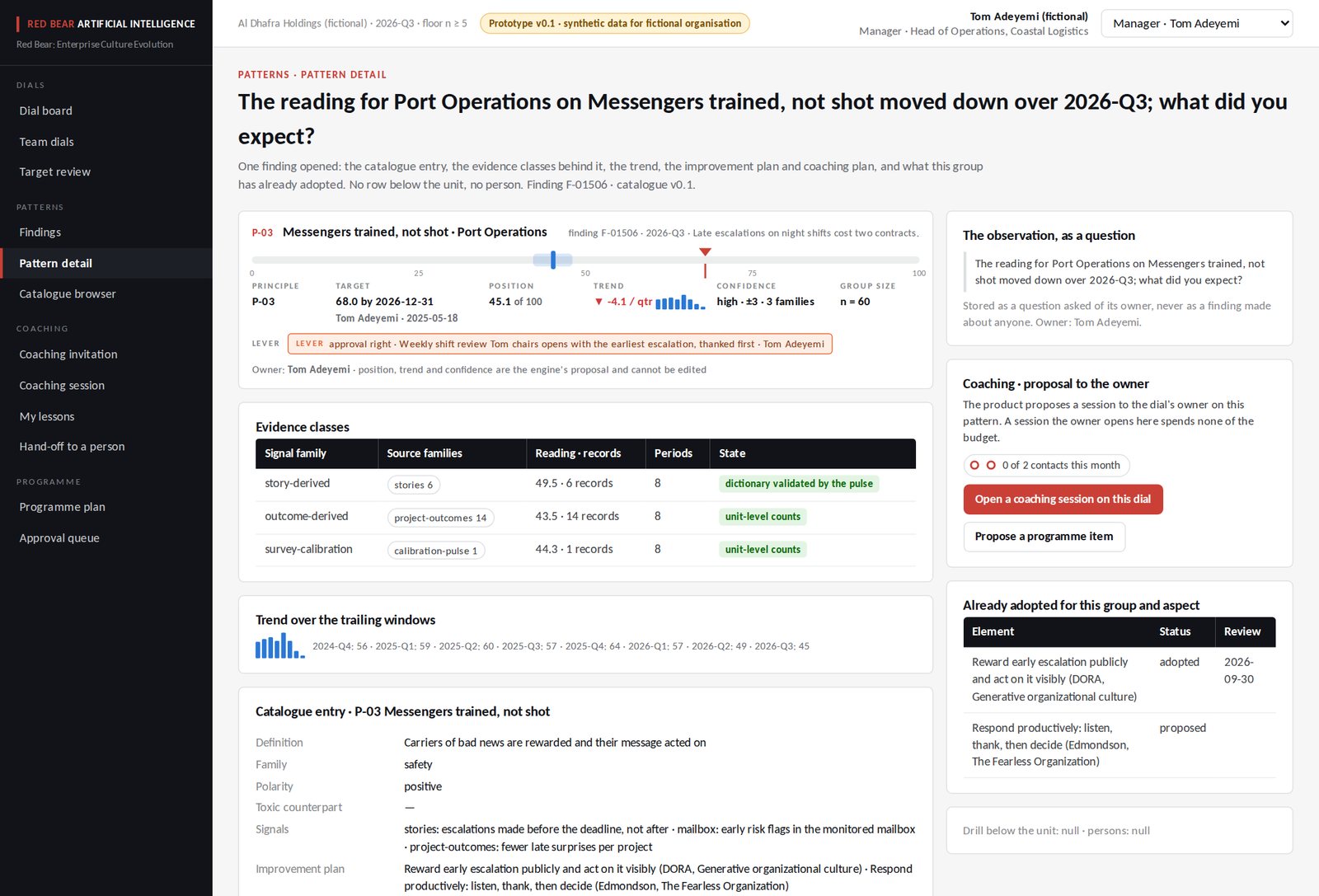
Coaching
Programme, health and governance
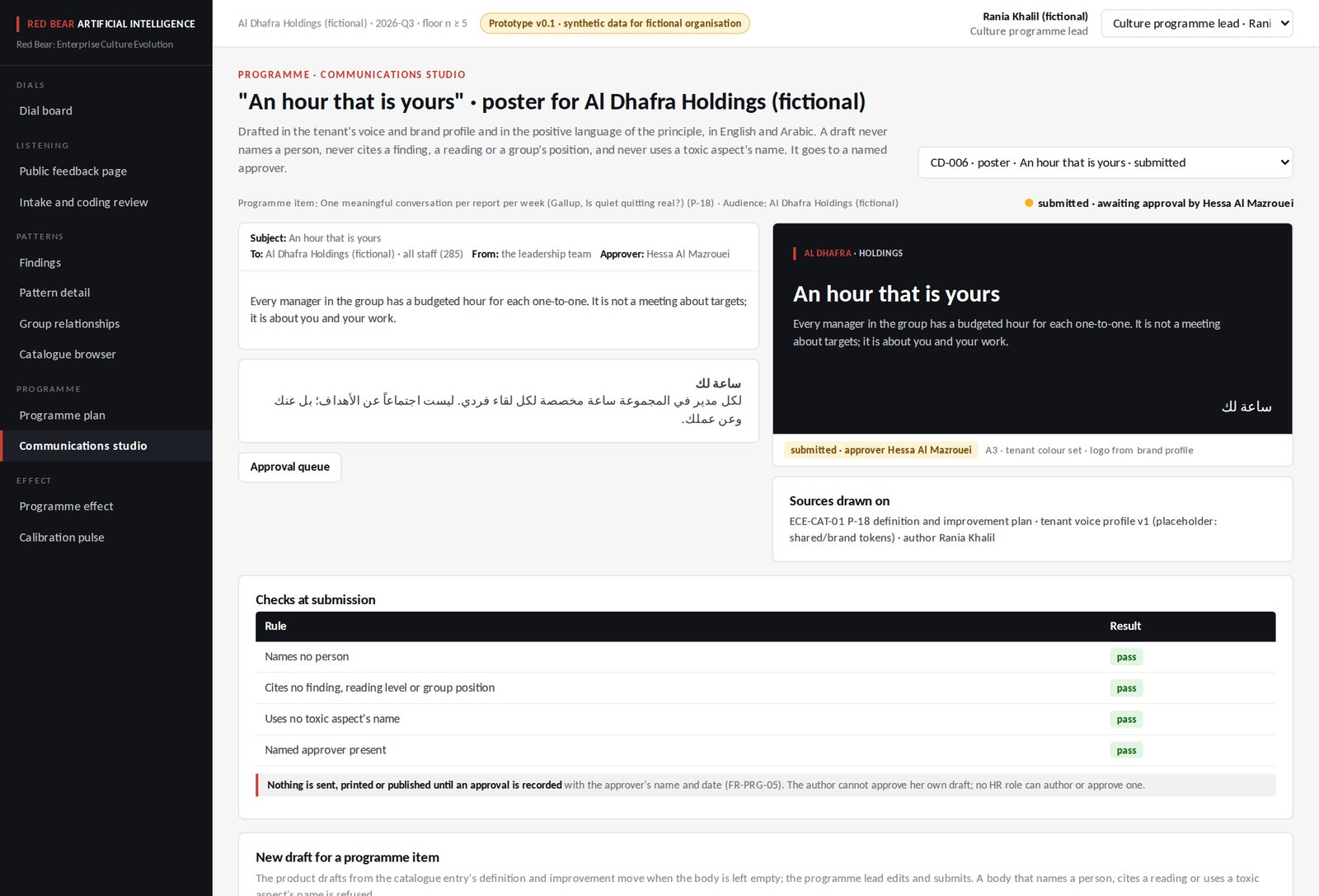
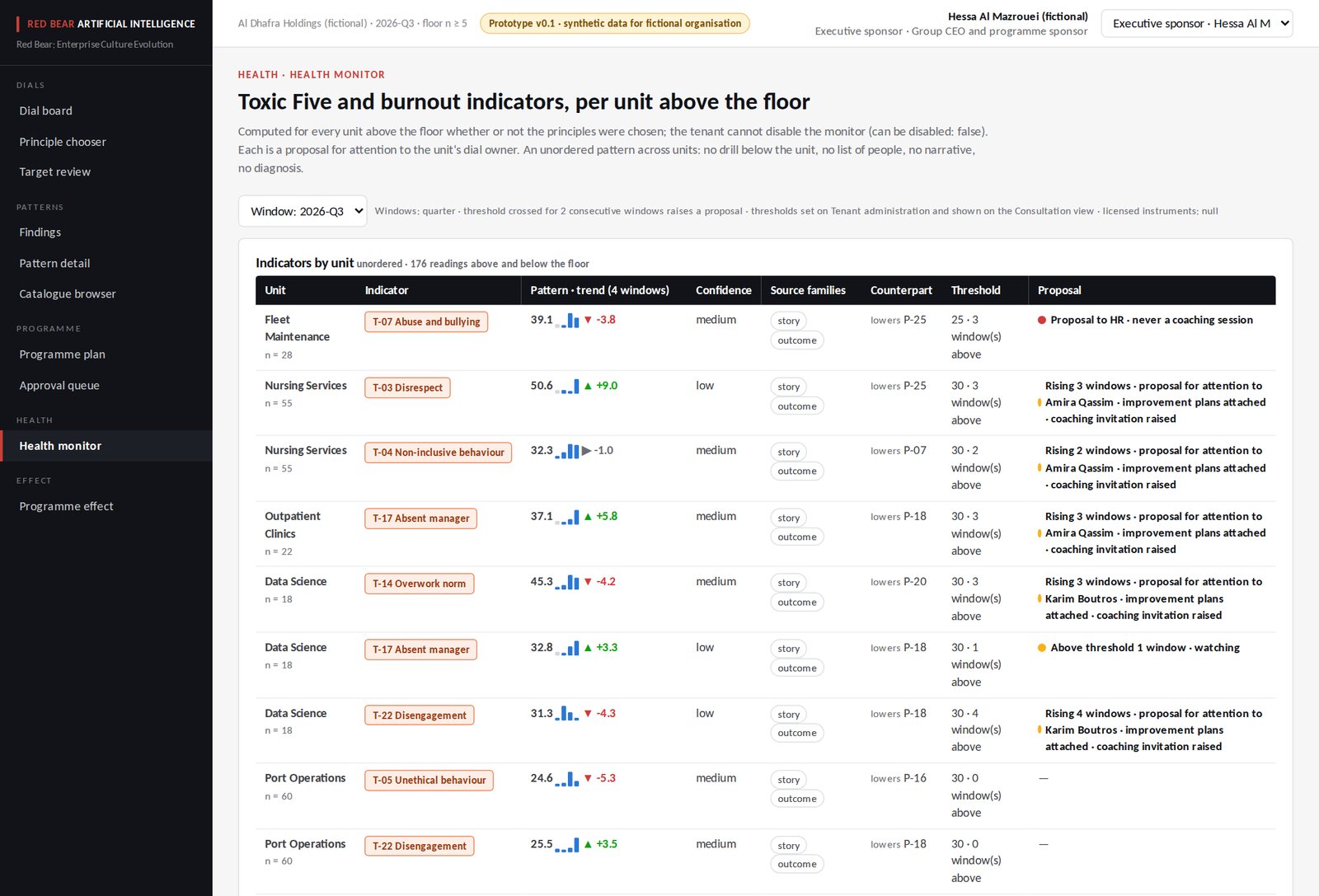
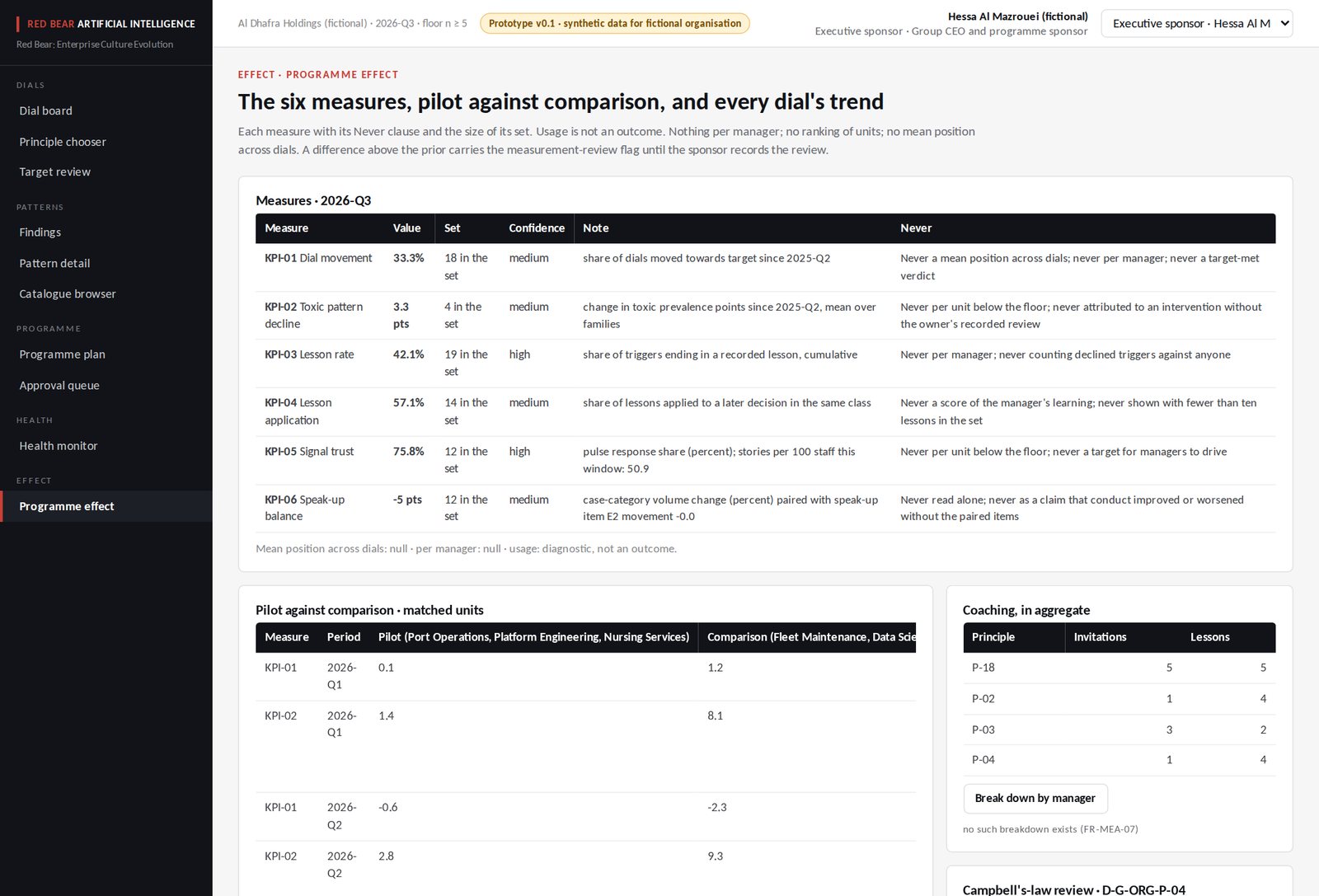
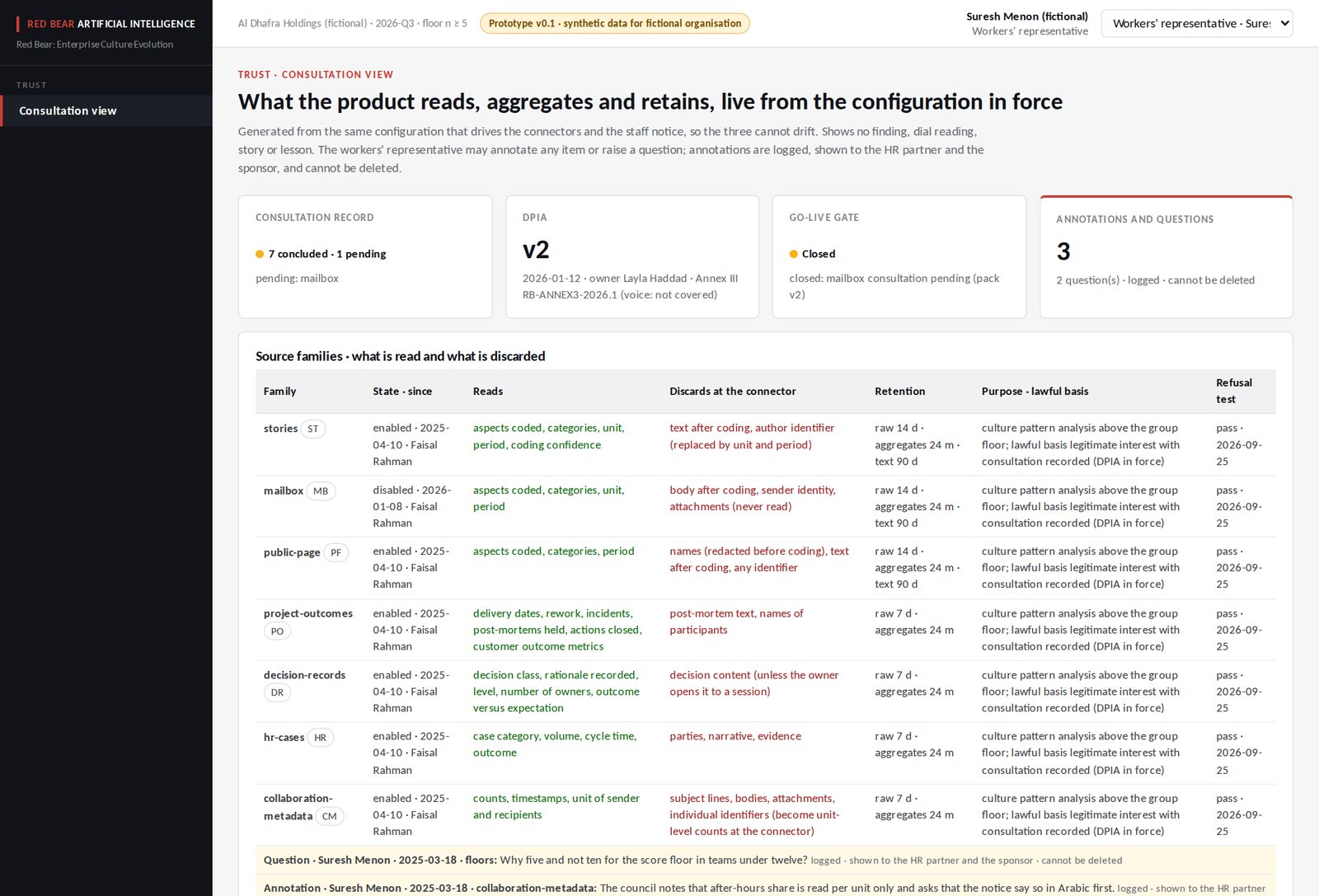
Read further
13 documents on this product
No form, no email address. The link downloads the PDF.
- White paper: Culture Coaching Without SurveillanceECE-WP-01 · v0.1
- White paper: Culture Analysis Without IndividualsECE-WP-02 · v0.1
- White paper: Privacy, Trust and No-AttributionECE-WP-03 · v0.1
- White paper: Breaking Down SilosECE-WP-04 · v0.1
- Data sheet: Enterprise Culture ManagerECE-DS-00 · v0.1
- Data sheet: Principles and Culture DialsECE-DS-01 · v0.1
- Data sheet: Signal intakeECE-DS-02 · v0.1
- Data sheet: Findings and patternsECE-DS-03 · v0.1
- Data sheet: CoachingECE-DS-04 · v0.1
- Data sheet: Programme and communicationsECE-DS-05 · v0.1
- Data sheet: Health monitoringECE-DS-06 · v0.1
- Data sheet: Measuring the programmeECE-DS-07 · v0.1
- Data sheet: Governance, consultation and administrationECE-DS-08 · v0.1
Considering a culture programme?
Tell us who is sponsoring it and what has prompted it, and we will tell you whether we can help.